
Herma: Two French Micro-Rotor Chronographs, Caliber 12 and 15
· Mamontrevintage

In 1970s French watchmaking, Herma marketed self-winding chronographs equipped with micro-rotor movements. Two watches from the Mamontrevintage catalog feature the 12 and 15 calibers from the Chrono-Matic family, with distinct displays and constructions.

Herma: from the Anguenot workshops in Villers-le-Lac
Herma's industrial history began in the Doubs, in Villers-le-Lac. Ulysse Anguenot settled there as an escapement manufacturer in 1871, then turned to making complete watches in 1893. Around 1907, he had a factory built on Rue de la Perrière, where the family business expanded.
On June 26, 1919, his sons Alfred and Gaston Anguenot founded the company Anguenot Frères. The Herma brand was registered in 1928. In 1948, the company had a new factory built on Rue Pierre-Berçot in Villers-le-Lac. These milestones are recorded in the Inventory of the Cultural Heritage of Bourgogne-Franche-Comté, which also traces the evolution of the company's industrial organization.
1969: Project 99 and the birth of the Chrono-Matic
During the 1960s, Heuer, Breitling, Hamilton-Büren and Dubois-Dépraz participated in a joint development program known as Project 99. The project combined an automatic movement base with a Büren micro-rotor and a chronograph module built by Dubois-Dépraz. This solution made it possible to add chronograph functions to an automatic watch movement.
On March 3, 1969, the partners unveiled the Caliber 11 at simultaneous presentations in Geneva and New York. It was subsequently offered in several Heuer, Breitling and Hamilton chronographs. Its modular architecture is notably distinguished by the crown positioned on the left of the case, while the chronograph pushers are located on the right.
This presentation took place the same year as the announcements and launches of the Zenith El Primero and Seiko 6139 automatic chronographs. Each of these developments adopted a different architecture. The Chrono-Matic family, for its part, evolved during the 1970s into several calibers, including the 12 and 15.
The Caliber 12: Two counters, 30 minutes and 12 hours
The Caliber 12 succeeded the Caliber 11. Its operating frequency was increased to 21,600 vibrations per hour, compared to 19,800 for the first caliber in the family. It retained the micro-rotor self-winding and the functions of the Dubois-Dépraz chronograph module.
The dial received a 30-minute counter at 3 o'clock and a 12-hour counter at 9 o'clock, in addition to the central chronograph hand. The movement thus allowed for measuring durations exceeding thirty minutes thanks to the hour counter.

The example presented by Mamontrevintage has an all-steel case measuring 40 mm excluding the crown. Its white dial with black counters, in the "panda" style, is paired with a black tachymetric bezel. The model sheet dates it to the first half of the 1970s.
The Caliber 15: An offset small seconds
In 1972, Heuer and Breitling introduced the Caliber 15, an evolution of the Caliber 12 designed to simplify chronograph construction. The 12-hour counter was removed, but the 30-minute counter at 3 o'clock was retained. The continuous small seconds was moved to 9:30, creating an asymmetrical dial.
The removal of the hour counter was accompanied by changes to the chronograph components. The principle of micro-rotor self-winding, characteristic of the Chrono-Matic family, remained.

The second Herma in the catalog is equipped with this Caliber 15. Its 39 mm steel case excluding the crown surrounds an anthracite grey dial and a midnight blue tachymetric bezel. The offset small seconds and 30-minute counter illustrate the layout unique to this version.

Sport chronographs in Herma advertisements
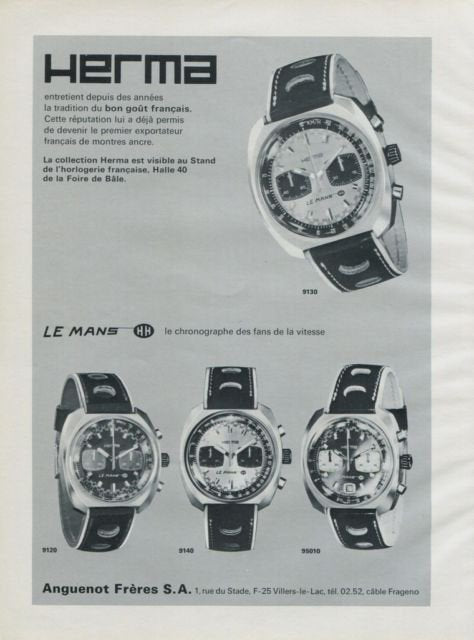
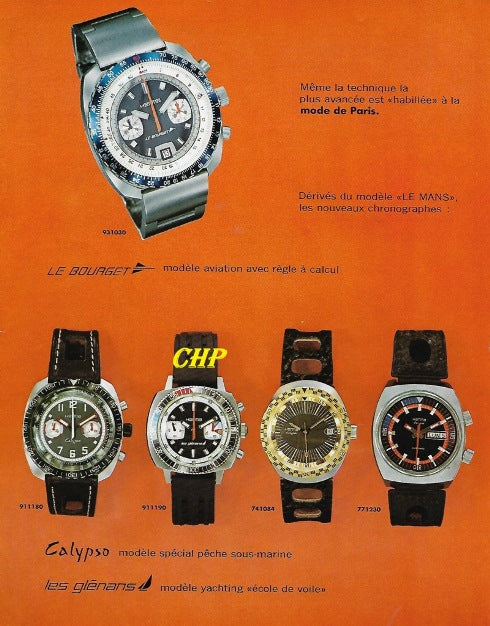
Herma's advertising communications from the 1970s highlight watches intended for motor racing, aviation and nautical activities. The Le Mans range occupies a prominent place, with dials featuring counters, tachymetric scales and cases characteristic of the era. These documents allow us to place the two chronographs studied here within the brand's broader sports catalog.
Two movements, two configurations
The two watches use the same micro-rotor automatic chronograph principle, but their functions differ. The Caliber 12 measures durations using 30-minute and 12-hour counters. The Caliber 15 retains a 30-minute counter and features an offset continuous small seconds. The difference is immediately apparent in the layout of the dials and the construction of the movements.
These Herma watches also document the circulation, by a French manufacturer, of a family of chronograph movements born from cooperation between Swiss and international watchmaking companies in the late 1960s.
The two Mamontrevintage examples
The photographs and individual characteristics appear on the Herma Caliber 12 and Herma Caliber 15 pages. The context of the project is also presented in our article Breitling Chrono-Matic 2112: 1969, the birth of the automatic chronograph.
Sources and documentation
Heritage Inventory — Anguenot Frères, Villers-le-Lac ; Heritage Inventory — Herma factory, rue Pierre-Berçot ; Hodinkee — Chrono-Matic and Project 99, Jeff Stein (2019) ; OnTheDash — comparison of calibers 11, 12 and 15 ; TAG Heuer — Monaco archives, caliber 15. Photographs of the pieces: © Mamontrevintage. Advertising sources indicated in their captions.